If you're in crisis, this comes first
Real numbers, by country, for the moment when what you need is a person and not an app. Plus the signs that breakup pain has turned into something worth taking to a professional.
What do I do if I can't take it anymore right now?
If you're thinking about hurting yourself, or you feel close to doing something you can't undo, call emergency services now — 911 in the United States, Canada, Mexico and Argentina, 999 in the UK, 112 in Spain — or your country's crisis line. You don't have to explain it well. Saying that you're in a very bad way and don't want to be alone is enough.
A crisis changes shape by the hour. Almost everything that helps right now is aimed at the same two things: buying time, and not being alone while the worst of it passes.
- 1
Tell someone now
Three words will do: «I'm not okay, can you call me?». Send it to whoever is there, even if they aren't the ideal person. Don't wait until you find the right way to say it, because there isn't one.
- 2
Put distance between you and anything that could hurt you
Pills, alcohol, whatever happens to be within reach tonight. Move it to another room or hand it to someone. Physical distance between you and the method is one of the most concrete things you can do in five minutes.
- 3
Call even if you don't know what to say
Nobody expects a prepared speech. You can open with «I'm not sure why I called». The people on the other end are trained for exactly that sentence.
- 4
Don't be alone until it eases
Go where there are people: the kitchen, a friend's place, a hospital emergency department. If nobody is available, stay on the phone with a helpline until the night lets up.
If you've already hurt yourself or taken something, this isn't a decision you can weigh calmly: call emergency services or go to an emergency department. Saying exactly what you took and how much changes the treatment, so don't hide it.
What crisis helpline can I call in my country?
Most countries have a free, confidential line answered by trained people. In the United States and Canada it's 988. In the UK and Ireland, Samaritans on 116 123. In Spain, 024. In Mexico, 800 911 2000. In Argentina, 135 or 0800 345 1435. In Colombia, 106 or 192 option 4. In Chile, *4141.
| Country | Line | Number | Hours |
|---|---|---|---|
| United States | Emergency services | 911 | 24 hours |
| United States | 988 Suicide & Crisis Lifeline | 988, by call, text or chat | 24 hours. Chat and text also available in Spanish |
| Canada | Emergency services | 911 | 24 hours |
| Canada | 9-8-8: Suicide Crisis Helpline | 988, by call or text | 24 hours, in English and French |
| United Kingdom | Emergency services | 999 | 24 hours |
| UK and Ireland | Samaritans | 116 123 | 24 hours. Free from landlines and mobiles |
| Spain | Emergency services | 112 | 24 hours |
| Spain | Line 024, suicidal behaviour helpline | 024 | 24 hours, 365 days a year |
| Spain | 016, violence against women | 016 · WhatsApp 600 000 016 | 24 hours. Doesn't appear on the phone bill |
| Mexico | Emergency services | 911 | 24 hours |
| Mexico | Línea de la Vida | 800 911 2000 | 24 hours, 365 days a year |
| Argentina | Emergency services | 911 | 24 hours |
| Argentina | Centro de Asistencia al Suicida | 135 from Buenos Aires city and greater Buenos Aires · 0800 345 1435 nationwide | 8:00 to 24:00 |
| Argentina | Line 144, gender-based violence | 144 | 24 hours, nationwide |
| Colombia | Emergency services | 123 | 24 hours |
| Colombia | Line 106 (in the cities where it operates) · Line 192, option 4, elsewhere in the country | 106 · 192 | 24 hours |
| Chile | Medical emergencies (SAMU) | 131 | 24 hours |
| Chile | Suicide prevention line | *4141 from a mobile | 24 hours, every day |
| Chile | Salud Responde | 600 360 7777 | 24 hours |
If your country isn't in the table, two international directories keep their listings current: findahelpline.com and befrienders.org. Both ask for your country and give you back the lines available there, with their hours and how to reach them.
In Argentina, the Centro de Asistencia al Suicida is run by volunteers, and in many time slots a single person is answering, so the line can be busy. The organization itself asks you to wait a little and try again. If you can't wait, call 911 or go to the emergency department of a public hospital, which is open around the clock.
When should I put the app down and call someone?
When what you need is for someone to act, not for someone to listen. An app — Over It included — can't call an ambulance, doesn't know where you are, and won't notice if you stop replying. If you're thinking about hurting yourself, if you've taken something, or if you don't think you can get through tonight, close the app and call.
Over It is built for the pain of a breakup: the long nights, the anxiety, the urge to text them. It isn't built for an emergency, and saying that plainly is part of using it well.
What Over It does not do
- It doesn't detect emergencies. You can type anything at all inside the app and no alarm goes off anywhere.
- Ninety is an AI character, not a person and not a health professional. It can get things wrong, and it can miss how serious what you're telling it actually is.
- The community is anonymous and voluntary. It isn't an on-call service: nobody is obliged to answer you, and nobody is awake at four in the morning because their shift says so.
- No one at Over It can call an ambulance for you, knows where you are, or follows up on anyone.
None of this is a flaw we plan to fix in a future release. A self-help app can't stand in for a crisis line or for a professional. That's why this page exists, and why every guide on the site links to it.
How do I know if breakup grief has become something that needs professional help?
Breakup grief hurts enormously and still moves: there are worse days and slightly better ones. It's worth seeing a professional when weeks go by with no relief at all, when the pain stops you sleeping, eating, working or studying, or when thoughts of hurting yourself show up. None of these signs is a diagnosis on its own.
Signs it's worth booking an appointment
- Thoughts of hurting yourself or of not wanting to go on, even brief ones that frighten you.
- Weeks have passed without a single better day: the intensity is exactly what it was on day one.
- You're not sleeping, or you're sleeping all day, and it has become the rule rather than the exception.
- You've stopped eating, or you're eating in a way that you yourself find off.
- You're missing work or classes, or you're there and can't do anything.
- You're drinking or taking pills so you don't have to feel.
- You've cut off everyone, and the idea of seeing someone feels worse than staying alone.
- Panic attacks or physical symptoms that won't go away.
You also don't need to tick the whole list. If you feel you can't carry this on your own, that's reason enough by itself. You can start by talking to someone, even if it isn't a professional yet.
What do I do if the person in crisis is someone else?
If someone tells you they want to die, take it seriously and ask directly: «are you thinking about killing yourself?». Listen without arguing or minimizing, don't promise to keep it secret, stay with them and help them call a crisis line. If the danger is immediate, call emergency services yourself and don't leave them alone.
- 1
Ask directly, with no euphemisms
«Are you thinking about killing yourself?». The National Institute of Mental Health in the United States states that asking about suicidal thoughts doesn't plant them or make them worse, and that talking about it can reduce them.
- 2
Listen without fixing
Don't argue, don't minimize, don't list everything they still have ahead of them. Staying there is enough, and so is letting them see that what they said didn't scare you off.
- 3
Don't promise to keep it secret
It's the one promise you can't make. You can put it like this: «I'm not going to leave you alone with this, and if we need help I'm going to ask for it».
- 4
Help them call, or call yourself
Look up the crisis line for the country that person is in and stay next to them while they call. If the risk is immediate, dial the emergency number yourself.
What is Over It, and what is it not?
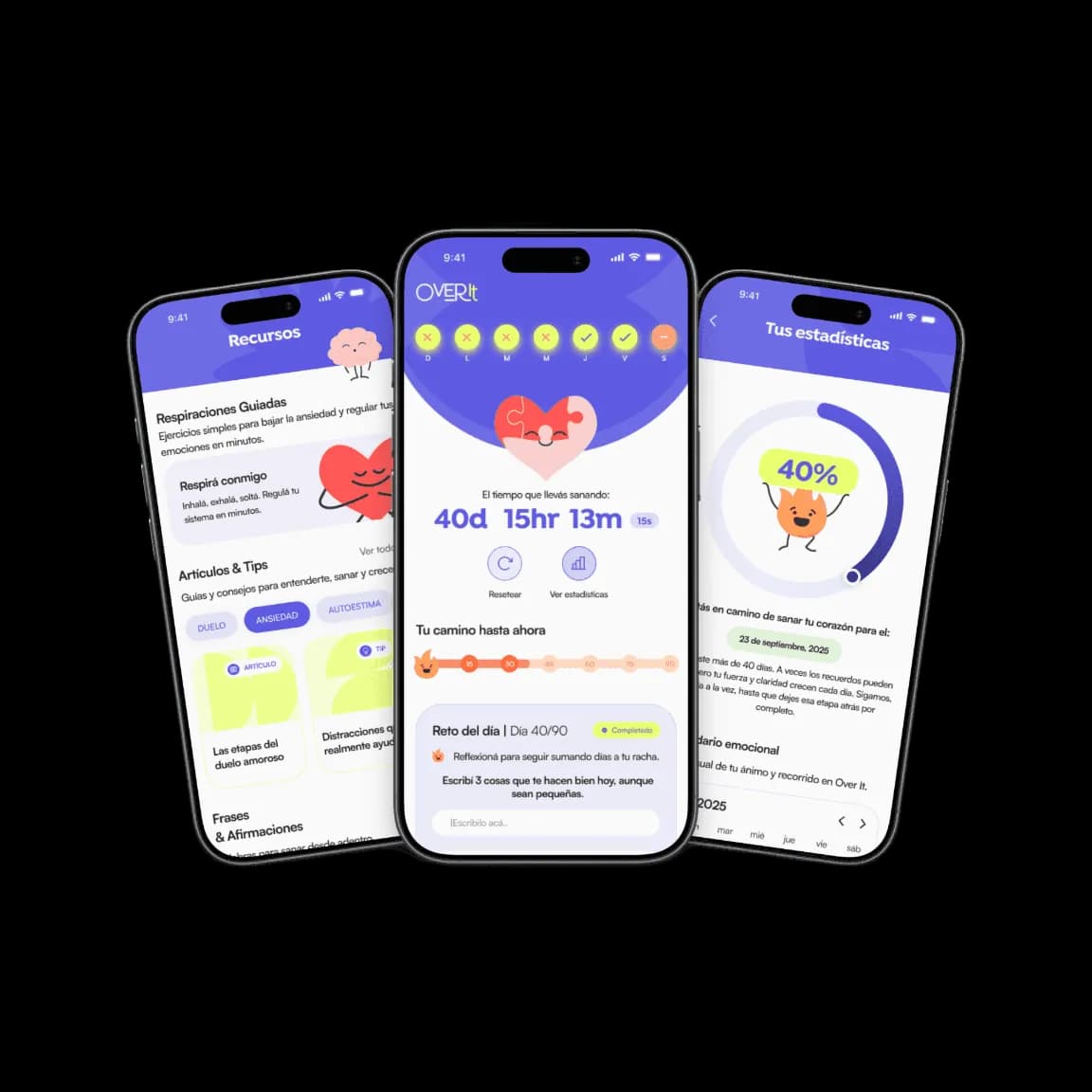
Over It is a self-help app for getting through a breakup. It includes an AI chat called Ninety, an anonymous community, guided breathing, daily challenges, a panic button, a mood tracker and articles. It runs on iOS; there is no Android version yet. It's available in English and Spanish. The download is free and full access goes through a subscription. It is not therapy and not a crisis service.
Inside the app there's a 24/7 emotional chat with Ninety, an anonymous community, guided breathing in crisis, relax and sleep modes, daily challenges with a streak, a panic button for the moment you're about to text them, a mood tracker and articles sorted by category.
The concrete facts: Over It runs on iPhone and iPad, through the App Store. There is no Android version yet. It's available in English and Spanish. The download is free and full access goes through a subscription; the price varies by country and changes over time, so the number that counts is the one you see in the App Store before you pay.
What Over It is not
- It isn't therapy and it doesn't replace it.
- It isn't a crisis service or an emergency line.
- Ninety isn't a therapist, isn't a person, and can be wrong.
- Nobody at Over It provides clinical follow-up for anyone.
The full breakdown of how the app works is on what Over It is.
Frequently asked questions
Is Over It a crisis service?
No. Over It is a self-help app for getting through a breakup: it's there for the hard days, not for emergencies. It doesn't detect situations of risk, it doesn't alert anyone, and there are no professionals on call behind it. If you're in danger, the right place is your country's emergency number or a crisis line, not an app.
Who do I call in the US, Canada or the UK if I'm in crisis?
In the United States and Canada, 988 answers by call and by text, 24 hours a day; the US service also has a chat, in English and Spanish, and the Canadian one answers in English and French. In the UK and Ireland, Samaritans answers on 116 123, free, 24 hours a day. If the danger is immediate, call 911 in the US and Canada, or 999 in the UK.
When should I see a therapist after a breakup?
When the pain doesn't ease at all as the weeks go by, when it stops you sleeping, eating, working or studying, when you're using alcohol or pills so you don't have to feel, or when thoughts of hurting yourself appear. Also when you simply want a space to put into words what's happening to you: you don't have to be at your worst to be entitled to an appointment.
Can I talk to someone if I can't afford therapy?
Yes. Every line on this page is free. Public health systems also cover mental health at no cost: in the UK, by asking your GP; in Spain, through your family doctor, who refers you on; in Argentina, through public hospitals and neighborhood health centers; in Mexico, the Línea de la Vida can point you toward specialized centers. University psychology clinics often run low-cost sessions too.
You're going through a breakup. You're not in this alone.
Over It is a guided path out of a broken heart, one day at a time.